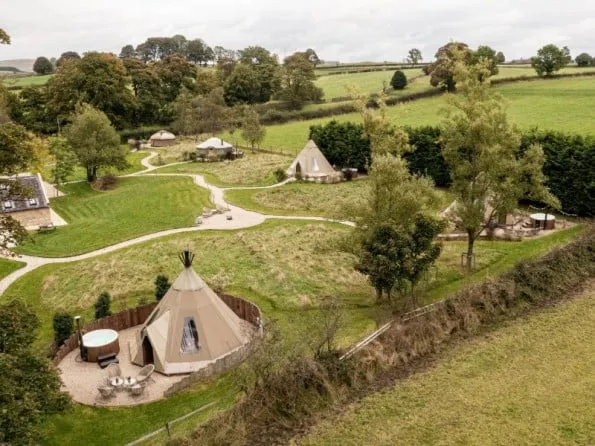
When the Lights Go Out, the Sky Switches On: Stargazing From Your Tipi Doorway

Photo by Photo by Hendrik Morkel on Unsplash on Unsplash
There's a moment on every good tipi weekend when the fire dies down, the last log settles into embers, and someone steps outside to fetch another bottle of something red. That's usually when they stop walking mid-stride, look up, and go quiet.
If you've never seen the Milky Way with your own eyes — not in a photo, not on a telly documentary, but arching overhead like spilled sugar — it's worth knowing that most of Britain can't show you. Around 85% of us live under light-polluted skies where only a handful of stars manage to punch through. Which means the handful of genuinely dark corners left on this island aren't just scenic. They're precious.
And the lovely thing? The best of them happen to be exactly where you'd want to sleep under canvas anyway.
Why Canvas Beats a Hotel Window
There's a practical reason a tipi is the ideal stargazing base: you can see the sky before you commit to the cold. Unzip the door flap, lean on the doorframe with a mug, and take it all in from the threshold. No trekking to a designated viewpoint. No car park. No getting in the motor at midnight to drive somewhere darker, when the whole point was to stop driving.
Better still, many tipi sites sit on farmland or moorland edges — precisely the kind of land that's been left alone by developers precisely because it's remote. The darkness and the peace tend to come as a package.
Where the Sky Goes Properly Black
Northumberland is the heavyweight champion. The county's International Dark Sky Park is one of the largest in Europe, and on a clear night you can see thousands of stars, the Milky Way stretching horizon to horizon, and — if you're lucky and it's the right time of year — the aurora borealis doing a rare cameo over Kielder Forest. Several tipi and glamping sites dot the area around the park, and the locals will tell you winter is when the sky really earns its keep.
The Brecon Beacons (Bannau Brycheiniog) in Wales hold their own Dark Sky Reserve status, and the valleys offer something Northumberland can't: dramatic silhouettes. Watching stars wheel over Pen y Fan while you sit wrapped in a wool blanket outside a canvas cone is a genuinely different experience from flat-horizon stargazing.
Exmoor was Europe's very first International Dark Sky Reserve, and it's got a trump card — you can sometimes see the sea from your pitch. Stars above, the faint hiss of surf below.
The Yorkshire Dales and Galloway Forest Park in Scotland round out the big hitters. Galloway in particular is so dark that rangers run stargazing events where they have to use red torches so nobody ruins their night vision on the way to the loo.
Timing It Right: The Meteor Shower Calendar
If you want the sky to put on a guaranteed performance, plan around one of the annual meteor showers. No telescope needed — just a reclining chair, a blanket, and patience.
- The Quadrantids (early January) — short, sharp, and freezing, but worth it if you're hardy.
- The Lyrids (late April) — a gentler warm-up act for the year.
- The Eta Aquariids (early May) — debris from Halley's Comet, best seen before dawn.
- The Perseids (mid-August) — the big one. Warm-ish nights, up to 100 meteors an hour at peak, and long summer evenings that mean you can wait comfortably.
- The Orionids (late October) — another Halley's Comet offering, best after midnight.
- The Geminids (mid-December) — arguably the most reliable show of the year. Bring everything warm you own.
The Perseids are the sweet spot for a first-timer: balmy enough to linger outside for hours, and the meteors come thick and fast enough that even the most sceptical member of your group will be pointing and gasping within twenty minutes.
The Cold-Night Survival Kit
Let's be honest about the main obstacle: British nights are chilly for roughly nine months of the year, and stargazing is a stationary activity. Stationary plus chilly equals miserable unless you plan for it.
The trick is layers you'd normally consider excessive. A proper insulated blanket or two — wool over fleece is the classic combo — plus a hat, because you lose a shocking amount of heat through your head. A hot water bottle filled before you settle in will keep a lap warm for a good hour. And a thermos of something hot isn't optional; it's structural.
Position matters too. Angle your chair toward the fire pit so you've got low warmth at your back and darkness overhead — the fire's glow won't ruin your night vision the way a phone screen would. Which brings us to the golden rule: red-light torches only, and phones face-down. It takes your eyes a good twenty minutes to fully adjust to the dark, and one bright screen resets the clock entirely.
Let the Sky Do the Talking
There's something quietly profound about standing in a doorway at midnight, canvas at your shoulders, watching a meteor burn up over a field that hasn't changed much in a thousand years. It's slow travel in its purest form — no itinerary, no booking, no signal required. Just you, a mug, and the oldest light show in Britain, playing nightly.
Pick a dark corner. Check the moon phase (a new moon means darker skies). And book the weekend that lines up with the Perseids if you can. The sky won't let you down — it never has.