One Field, One Village: Following the Money From a Tipi Site to the Village Shop
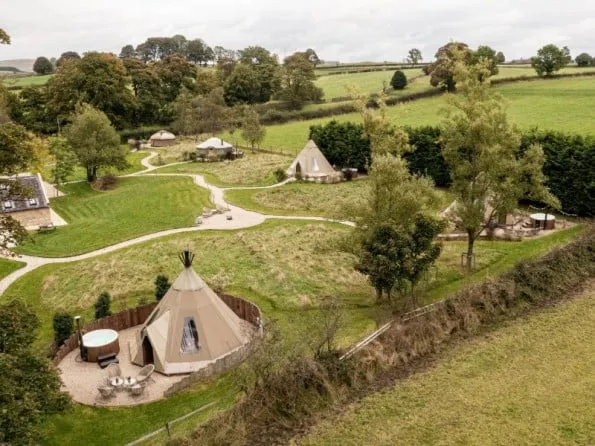
Photo: glamping tipi site in green field next to English village with stone cottages, via www.oneoffplaces.co.uk
There's a moment, usually on the second morning of a tipi weekend, when you realise you've run out of milk. So you wander down the lane, find the village shop, and buy milk — plus, inevitably, a bacon roll, a bag of locally roasted coffee and a jar of chutney you didn't know you needed.
That little transaction is the quiet engine of what you might call the tipi economy. And once you start looking for it, you see it everywhere.
The £40 Night That Spends £150
Here's the thing about a tipi booking: the fee the guest pays the landowner is only the beginning. Unlike a hotel, where the money largely vanishes into a corporate till, a glamping site pushes almost everything sideways into the local economy.
Guests arrive on Friday evening and head straight for the village pub — often the only pub for miles, and often one that's struggled since the pandemic. They eat there. They drink there. They come back on Saturday night, a little sooty from the fire pit, and do it all again.
On Saturday morning they discover the farm shop. They buy sausages for the barbecue, eggs with actual dirt on them, a loaf from the bakery two villages over. Some book a yoga class or a foraging walk. Nearly all of them leave with something they'd never have bought at home.
One site owner in the Welsh borders told me she reckons every booking puts somewhere between £100 and £150 into businesses within a five-mile radius, once food, fuel and the odd impulse purchase are tallied up. On a site running thirty nights a month through summer, that's a serious chunk of change for a place with one shop and two pubs.
The Firewood Man's Best Customer
Then there are the suppliers you don't think about. Firewood. And lots of it.
A single tipi site with fire pits and log burners can get through a small forest's worth of seasoned logs over a season. For one forester in Somerset, glamping sites now make up the majority of his firewood trade — steady, predictable custom that keeps him felling, splitting and employing a part-time helper through the winter.
Multiply that out and the picture grows: the linen laundry service, the portaloos and their inevitable servicing round, the local handyman who mends the decking every spring, the woman who runs the honesty-box coffee hut at the entrance. A tipi site is a small business that behaves, economically speaking, like a much bigger one.
But What About the Locals?
Now for the awkward bit, because not everyone's raising a glass to the glamping boom.
Housing is the obvious flashpoint. In tourist-heavy corners of Cornwall, the Lakes and rural Wales, second homes and holiday lets have helped push prices beyond the reach of the people who grew up there. Glamping sites don't consume houses the way holiday lets do — no one's buying up the cottage stock to pitch a tipi in it — but the money is still real estate money, and farmland prices near successful sites don't go down.
There's also the traffic question. A narrow lane built for tractors and one school bus can feel very different when it's carrying a steady stream of estate cars with roof boxes. And there's the occasional grumble about noise — though, honestly, tipi crowds are more likely to be quietly stargazing than staging a rave.
The fairest criticism is this: the benefits of a tipi site are spread thin and wide, while the annoyances land on a handful of immediate neighbours. That's a planning conversation, and it's one more and more parish councils are having.
So Which Is It — Regeneration or Erosion?
The honest answer is that it depends entirely on how a site is run. The ones that bed in well tend to share a few traits: they employ locally, they buy locally, they point guests towards the pub and the shop rather than telling them to bring everything from a big out-of-town supermarket, and they keep their footprint — literal and social — modest.
The best owners I've spoken to treat themselves as part of the village, not apart from it. One hosts an end-of-season supper for neighbours. Another buys all his logs, eggs and flowers within walking distance and says so in the welcome pack, partly out of principle and partly because it's rather good marketing.
And that's the case for optimism. Alternative stays like tipis are, by their nature, small and scattered. They can't be scaled into a chain, they don't hollow out a high street the way a row of buy-to-let flats can, and their success is tethered to the health of the businesses around them. A tipi site needs a living village far more than a village needs any one tipi site.
What It Means For The Way We Travel
For guests, the takeaway is simple and rather pleasant: where you spend your weekend money matters. Book the site that recommends the local butcher. Walk to the pub instead of driving to the services. Buy the chutney.
Slow travel isn't only about how you get somewhere — it's about what you leave behind when you go. And done well, a weekend under canvas leaves behind a bit more than footprints in a field. It leaves a fuller till at the village shop, a busier Saturday at the pub, and a firewood man with work through the winter.
Not a bad return on one night's sleep.